




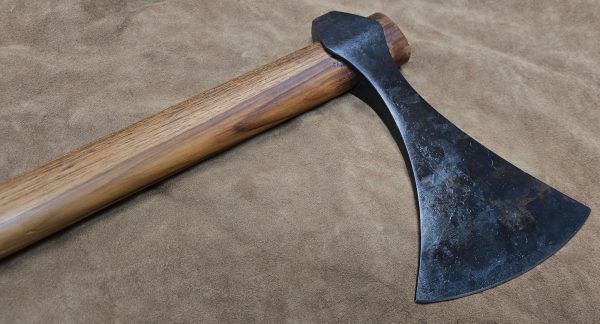
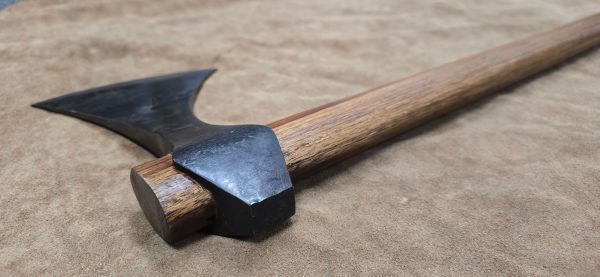
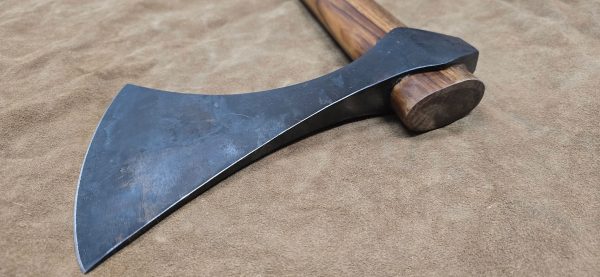
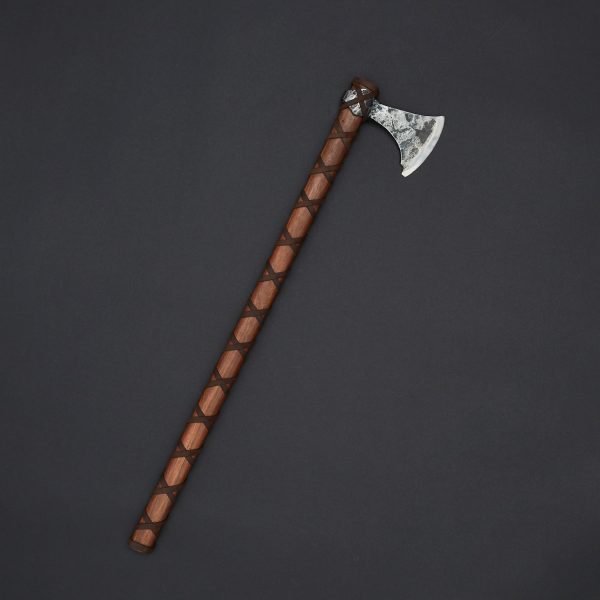
The Viking Langøx (#1774)

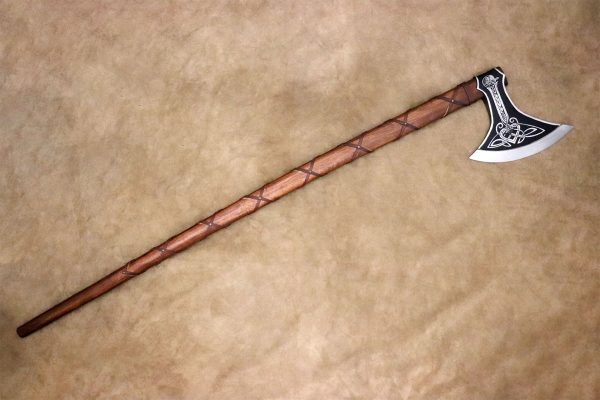
The Saga of the Volsungs, also known as the Völsunga saga, is one of our most famous surviving epic works of prose in Old Norse. A 13th century work based on a much older myth and Legend. In these sagas, Viking warriors were masters of the axe, a weapon as vital to their survival as it was to their conquests. Unlike the shorter, handier axes, the Langox, or Long Axe, is fitted on an extended shaft, a crucial design element that allowed for devastating, far-reaching swings in close-quarters battle. This offers superior reach and leverage for powerful, decisive blows.
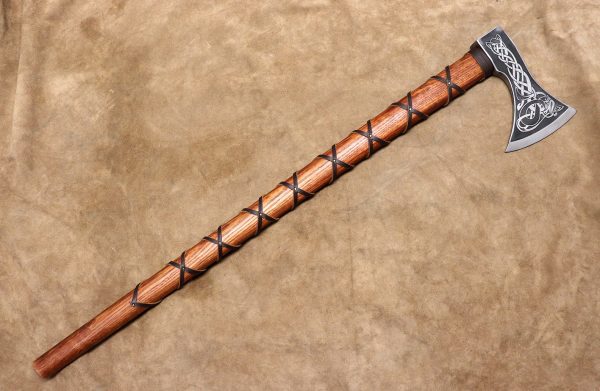
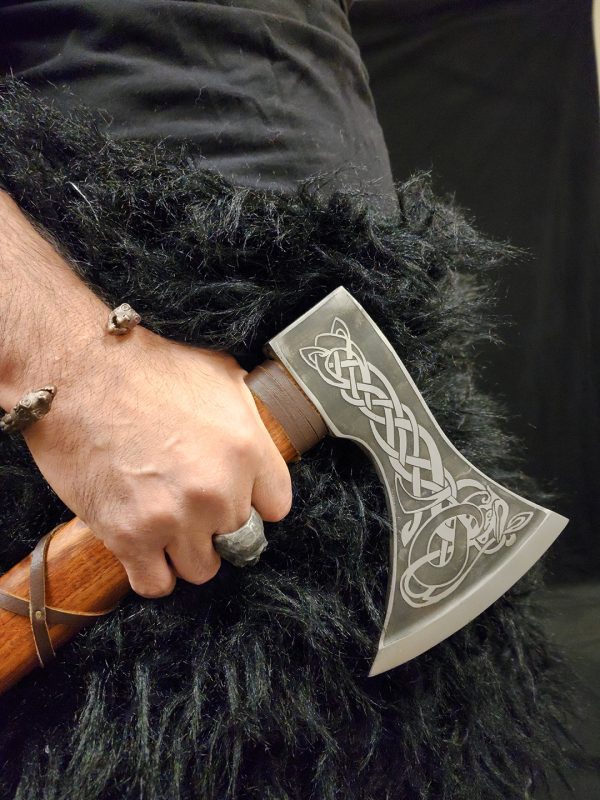
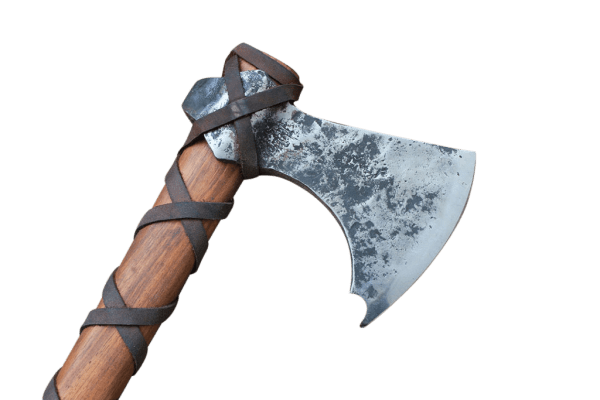
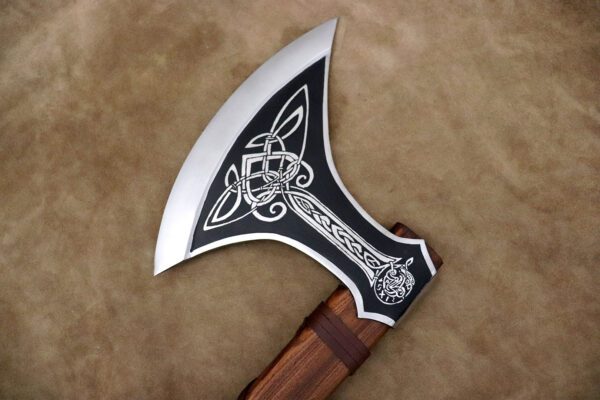
Drawing inspiration from excavated axe heads, our team has forged the axe while keeping the form and functionality of the Dane or Broadaxe – weapons renowned for their immense cutting power and extended range. Every curve of the blade, every detail of the haft, reflects a weapons that shaped an era.
Total Length : 42”
Viking Axe head (width): 6”
Viking Axe head (Hight) 10” long
Weight: 3 lbs. 5 oz.
CAD350.75 CAD392.84Price range: CAD350.75 through CAD392.84
“So King Lyngi let send the war-message all throughout his realm, and has no will to flee, but summons to him all such as would give him aid. So he came against Sigurd with a great army, he and his brothers with him, and an exceeding fierce fight befell; many a spear and many an arrow might men see there raised aloft, axes hard driven, shields cleft and byrnies torn, helmets were shivered, skulls split atwain, and many a man felled to the cold earth.”
– The Völsunga Saga, CHAPTER XVII. Of Sigurd’s Avenging of Sigmund his Father
Despite what modern pop culture teaches us about the history of Western Europe, the sword was not the most common weapon of the ancient world – nor was it the most effective. Across many different kingdoms that rose and fell, other weapons were at the forefront of every battle. the spear, the longboat, the polearm – all of these had their place as the most common, most fearsomely efficient close quarters weapon. For the Norse, also called the Vikings, the weapon that won them through raids, battles, wars, and conquest was the axe. And of these accidents, there was perhaps none as famous nor as feared as the long axe.
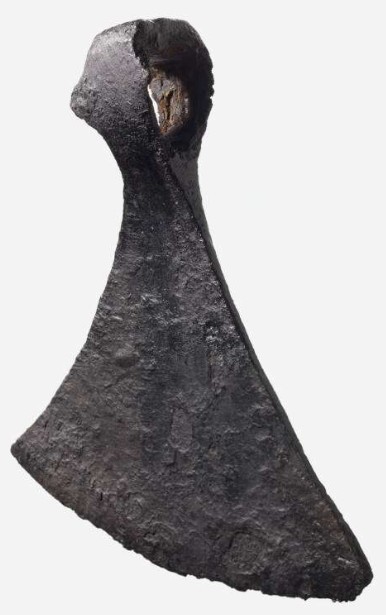 Like other war axes, the Langøx is a descendant of those crude, early tools that were a mainstay of every hearth and home. Cutting wood for fire and for homebuilding is a worldwide practice throughout human history, and the ancestors of the Norse are no exception. An axe required less high-quality metal to make than did a sword, which made it a natural choice when creating early weapons for people to use against their fellow humans. By changing the shape of the woodcutting axe – slimming the head, lengthening the blade – it became much more suitable for wielding in battle. Though it lacked the reach of a spear an axe could be devastatingly effective in close quarters while taking up comparatively little space, which for the ship-bound Viking raiders who would need to be able to carry all of their gear on their person made it an ideal choice.
While the origins of the Viking long axe may be humble, though, what sets it apart is the level to which it was elevated in Norse culture. One indication is the sheer number of axes recovered from Norse graves; while the handles would often break down the heads of bearded axes (Skeggøx), broad axes (Breiðøx), and long axes (Langøx) have all been discovered in graves noble and mean. These weapons could be simple or ornate, decorated or plain, and designed for all sorts of combat needs – shorter hand axes for defense, throwing, or utilitarian use; long axes for the practical application of physics to the problem of war. The long axe has th
is science behind it all the way; by lengthening the handle of an axe the force of its blows would be multiplied, and a warrior could deliver powerful blows that would break shield, armor, and the enemy beneath.
The Darksword Armory Viking Langøx is our latest design, inspired by the Dane axe/broadaxe design that was so popular among Viking warriors – if the archeological evidence is any indication, that is. Unlike some of our other axes which include intricate knotwork and other decorative elements, this axe is a no-nonsense design made with pure function in mind – its blackened steel head kept free of adornment, easier to clean without ruining the finish of some lordly fellow’s fancy axe. The head is shaped with a slender neck and a wide cutting edge, narrow enough to reduce unnecessary weight but still capable of devastating blows. The long hardwood handle is stout and no-nonsense, bringing the length of the weapon to three-and-a-half feet – creating powerful force at the end of each swing. This is one of the longest axes we’ve ever made, and it is made to reach as far as you need it to.
Total Length : 42”
Viking Axe head (width): 6”
Viking Axe head (Hight) 10” long
Weight: 3 lbs. 5 oz.
Be the first to review “The Viking Langøx (#1774)”
Related products
CAD385.83 CAD427.92Price range: CAD385.83 through CAD427.92
This product has multiple variants. The options may be chosen on the product page
customizable
CAD933.00 CAD1,157.48Price range: CAD933.00 through CAD1,157.48
This product has multiple variants. The options may be chosen on the product page
Out of stock
CAD287.62 CAD315.68Price range: CAD287.62 through CAD315.68
This product has multiple variants. The options may be chosen on the product page
Out of stock
CAD287.62 CAD315.68Price range: CAD287.62 through CAD315.68
This product has multiple variants. The options may be chosen on the product page
CAD385.83 CAD427.92Price range: CAD385.83 through CAD427.92
This product has multiple variants. The options may be chosen on the product page
CAD385.83 CAD427.92Price range: CAD385.83 through CAD427.92
This product has multiple variants. The options may be chosen on the product page
customizable
CAD989.12 CAD1,213.60Price range: CAD989.12 through CAD1,213.60
This product has multiple variants. The options may be chosen on the product page
customizable
CAD940.01 CAD1,164.49Price range: CAD940.01 through CAD1,164.49
This product has multiple variants. The options may be chosen on the product page
customizable
CAD1,003.15 CAD1,227.63Price range: CAD1,003.15 through CAD1,227.63
This product has multiple variants. The options may be chosen on the product page
×
❮
❯
![]()
Reviews
There are no reviews yet.