




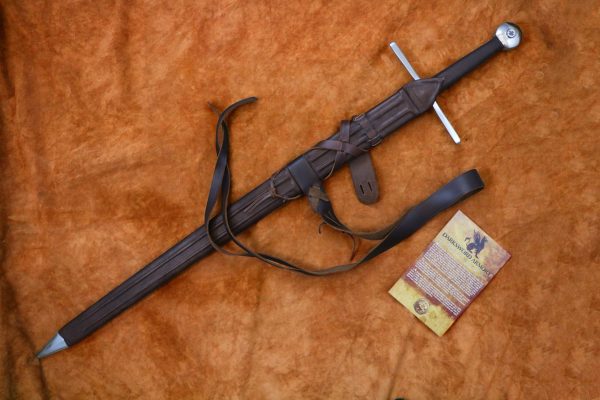
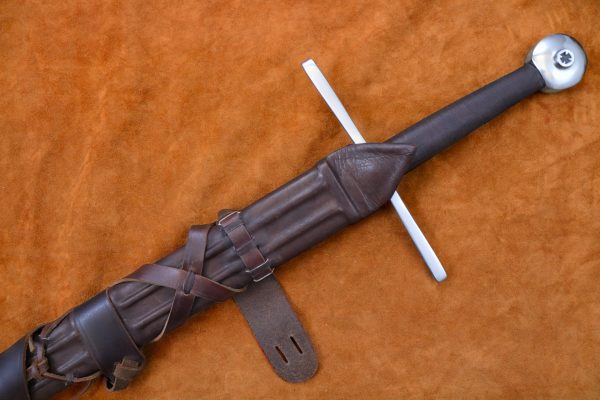
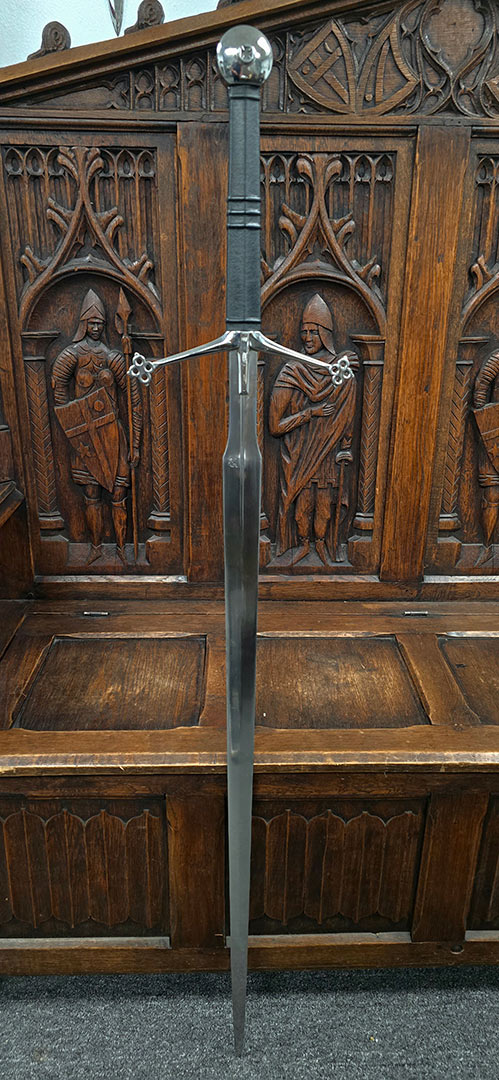
(Sword on Sale) Two Handed Templar Sword (#98907)

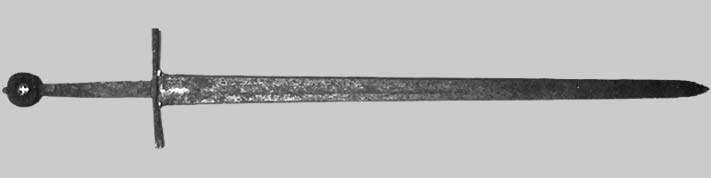
1300 – 1350 A.D Museum of London, original found in the River Thames in London.
Type: XIIIa
Relative condition: 8/10
Structural integrity: 9/10
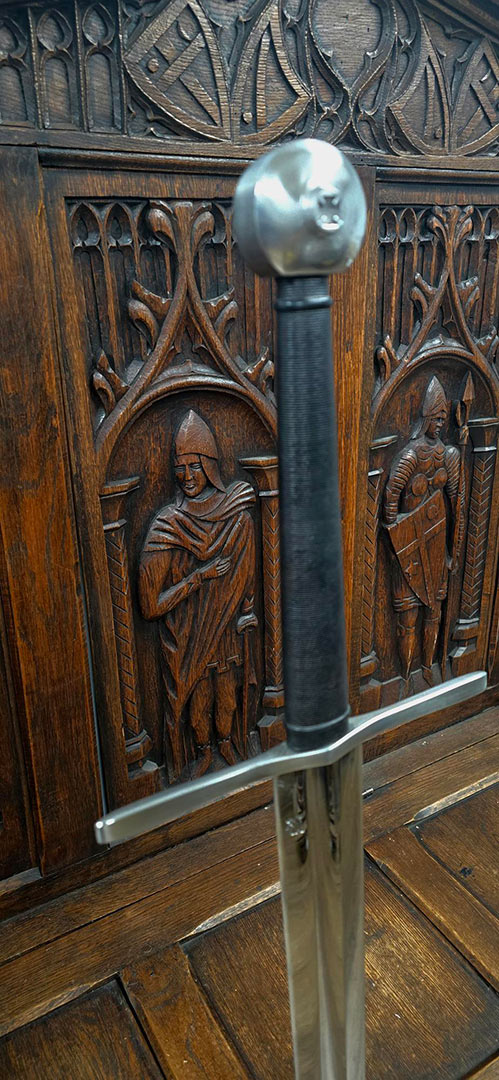
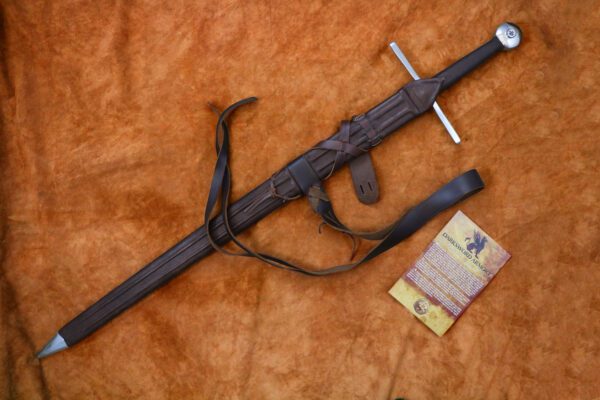
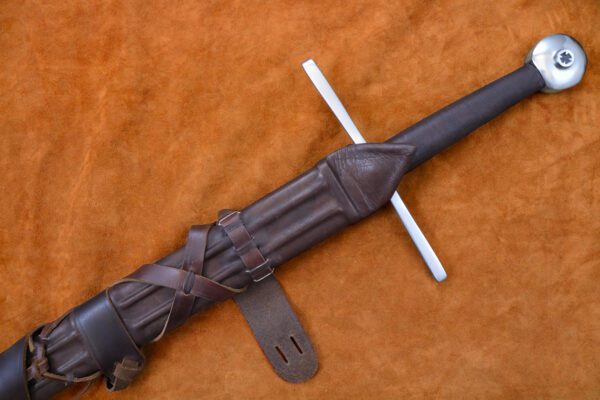
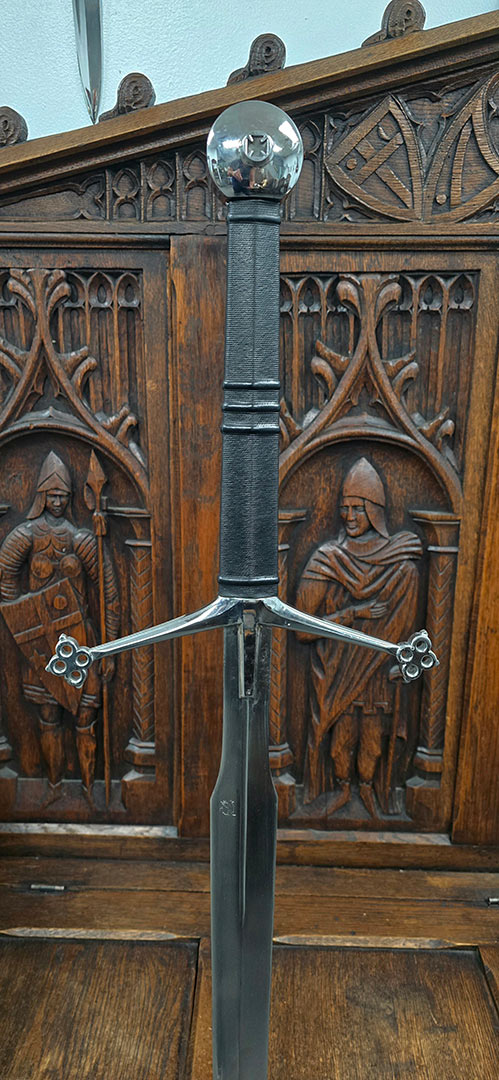
Reason of sale: This sword was used in a documentary film. The sword was not used in combat but does show signs of dry handling. There are some minor scratches on the guard and blade. The blade is in very good condition and the sword’s structural integrity remain intact. It can be used in combat and cutting tests. As with all orders, the sword will be thoroughly polished and inspected prior to shipping.
Two Handed Templar Sword
1300 – 1350 A.D Museum of London, original found in the River Thames in London.
Type: XIIIa
Blade: 5160 High Carbon Steel. Dual Tempered HRc 60
48-50 at the core
Total length: 47″
Blade length: 36″
Blade width at base: 2″
Weight: 4 lbs. 6 oz.
POB: 6″
USD500.00 USD660.00Price range: USD500.00 through USD660.00
1300 – 1350 A.D Museum of London, original found in the River Thames in London.
Type: XIIIa
Relative condition: 8/10
Structural integrity: 9/10
Reason of sale: This sword was used in a documentary film. The sword was not used in combat but does show signs of dry handling. There are some minor scratches on the guard and blade. The blade is in very good condition and the sword’s structural integrity remain intact. It can be used in combat and cutting tests. As with all orders, the sword will be thoroughly polished and inspected prior to shipping.
“A Templar Knight is truly a fearless knight, and secure on every side, for his soul is protected by the armour of faith, just as his body is protected by the armour of steel. He is thus doubly armed, and need fear neither demons nor men.”
Bernard de Clairvaux, c. 1135,
De Laude Novae Militae—In Praise of the New Knighthood
Two Handed Templar Sword
1300 – 1350 A.D Museum of London, original found in the River Thames in London.
Type: XIIIa
Blade: 5160 High Carbon Steel. Dual Tempered HRc 60
48-50 at the core
Total length: 47″
Blade length: 36″
Blade width at base: 2″
Weight: 4 lbs. 6 oz.
POB: 6″
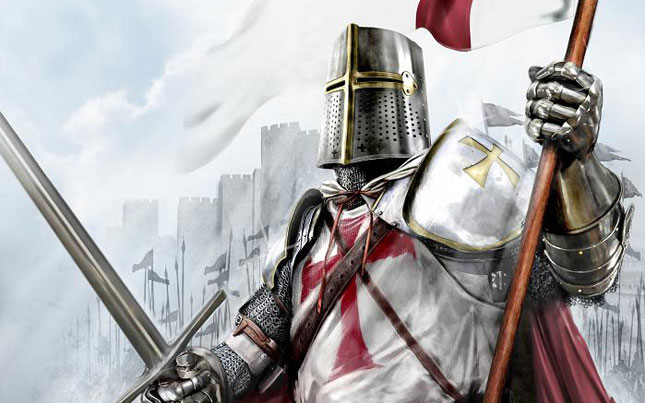
For nearly two centuries, the Poor Fellow-Soldiers of Christ and of the Temple of Solomon – known as the Knights Templar – were a political, military, and religious force in Europe and the Middle East. Formed at the end of the First Crusade as a group of knights – originally French – who took monastic vows, they swore to protect pilgrims travelling from Europe to the Holy Land. Their headquarters was in Jerusalem on the Temple Mount, which led to their name (which references the Temple of Solomon). While the Order began without wealth, living off donations from villagers, the Templar Knights emerged as an extremely wealthy and politically powerful organisation. One of the reasons for this was Pope Innocent II’s 1139 proclamation that exempted the Order from local laws, which left them answerable to no government except the Pope himself. This catapulted them from an order of militaristic monks into a political force to be reckoned with.
Initially, the Knights Templar were a military order – and a wildly successful one, with stores of their mounted knights breaking much superior forces. However, as the Order expanded, they began branching out in new and innovative directions. The Order became an early form of bank, able to receive deposits, hold valuables and funds, and provide loans – with interest, previously forbidden to church organisations. This newfound ability became the Order’s primary focus, and their activities changed to match. Many wealthy and powerful people found themselves in debt to a military order that was above the law in every sense of the word. One such individual was King Phillip IV of France, who was deeply indebted to the Order. King Phillip initiated the fall of the Order in 1307, arresting many Knights Templar and torturing them into admitted to heresy. Facing political pressure as a result of the scandal, Pope Clement ordered the Order dissolved in 1312. Many of their members were executed, their assets were seized and distributed to other orders of the Church, and the last Grand Master, Jacques de Molay, was burned at the stake in 1314. The greatest military force of the Crusader era was gone.
Despite this fall from grace, the Knights Templar have captured the imagination of modern sword collectors and history enthusiasts. Their weapons have been the subject of much interest, and while many of the original weapons were destroyed and or thrown into rivers following the dissolution of the Order, a handful of good examples survived. Numerous photographs of the original Two Handed Templar sword are published in “The Journal of Arms and Armour Society”, (Oakeshott, E. “A war sword of the XIVth Century in the Guildhall Museum”). The sword of the crusaders and the Templar Knights, in their crucifix form, exemplifies the archetypical Sword of the middle ages.
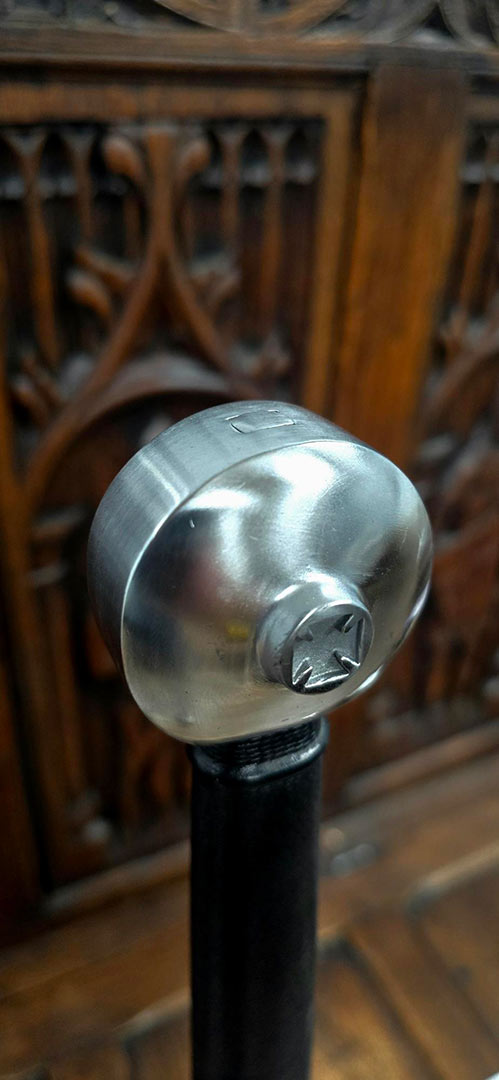
The embellishing of the pommel, with its decorative cross, was common on Templar swords. As a medieval weapon, the Two handed Templar sword is an imposing, powerful yet elegant piece. Hefty, yet carefully balanced for optimum functionality, the sword is resilient, reliable and virtually indestructible. meticulously crafted with a 2.3” wide blade, the Templar sword not only provides devastating cuts but can thrust through armor with unrivalled ease. In a nutshell, the Two handed Templar sword is a dependable sword that will last for generations.
Photograph of the original sword, on display at the Museum of London, in England.
Be the first to review “(Sword on Sale) Two Handed Templar Sword (#98907)”
Related products
Sale!
Original price was: USD990.00.USD750.00Current price is: USD750.00.
Sale!
Out of stock
USD535.00 USD695.00Price range: USD535.00 through USD695.00
This product has multiple variants. The options may be chosen on the product page
Sale!
USD590.00 USD740.00Price range: USD590.00 through USD740.00
This product has multiple variants. The options may be chosen on the product page
Sale!
Original price was: USD1,200.00.USD500.00Current price is: USD500.00.
Sale!
Out of stock
USD480.00 USD610.00Price range: USD480.00 through USD610.00
This product has multiple variants. The options may be chosen on the product page
Sale!
Out of stock
USD550.00 USD710.00Price range: USD550.00 through USD710.00
This product has multiple variants. The options may be chosen on the product page
Sale!
Original price was: USD92.00.USD45.00Current price is: USD45.00.
Sale!
Out of stock
USD450.00 USD535.00Price range: USD450.00 through USD535.00
This product has multiple variants. The options may be chosen on the product page
Sale!
Original price was: USD100.00.USD50.00Current price is: USD50.00.
Sale!
Original price was: USD115.00.USD50.00Current price is: USD50.00.
Reviews
There are no reviews yet.